
Install Jonot
Download all Jonot native apps from
downloads.jonot.io. Each release has a versioned
archive path that does not change and a latest/ path that updates with each
release and has a short cache lifetime.
Jonot Host
Section titled “Jonot Host”The Jonot Host app runs on a back-office Linux machine and keeps queues running through internet outages, syncing automatically when connectivity returns.
| Package | Link |
|---|---|
Debian / Ubuntu (.deb) | jonot-host-linux.deb |
Fedora / RHEL (.rpm) | jonot-host-linux.rpm |
Install via apt (Debian / Ubuntu)
Section titled “Install via apt (Debian / Ubuntu)”Add the Jonot repository once, then use apt upgrade for future updates:
curl -fsSL https://downloads.jonot.io/host/latest/jonot-host-public.asc \ | sudo gpg --dearmor -o /usr/share/keyrings/jonot-host.gpgecho "deb [signed-by=/usr/share/keyrings/jonot-host.gpg] https://downloads.jonot.io/host/apt stable main" \ | sudo tee /etc/apt/sources.list.d/jonot-host.listsudo apt update && sudo apt install jonot-hostInstall via dnf/rpm (Fedora / RHEL)
Section titled “Install via dnf/rpm (Fedora / RHEL)”Add the Jonot repository once, then use dnf upgrade for future updates:
sudo rpm --import https://downloads.jonot.io/host/latest/jonot-host-public.ascsudo tee /etc/yum.repos.d/jonot-host.repo <<'REPO'[jonot-host]name=Jonot Hostbaseurl=https://downloads.jonot.io/host/rpmenabled=1gpgcheck=1repo_gpgcheck=1gpgkey=https://downloads.jonot.io/host/latest/jonot-host-public.ascREPOsudo dnf install jonot-hostmacOS and Windows
Section titled “macOS and Windows”| Package | Link |
|---|---|
macOS (.dmg) | JonotHost-latest.dmg |
Windows (.msi) | JonotHost-latest.msi |
The macOS and Windows builds update themselves in place once installed:
Sparkle on macOS, WinSparkle on Windows. The Linux .deb / .rpm packages
update through the apt/dnf repository configured above.
Jonot Kiosk, Desk, and Display desktop clients
Section titled “Jonot Kiosk, Desk, and Display desktop clients”The kiosk, desk, and display apps also run as native desktop clients on Windows, macOS, and Linux. They show the web app in an embedded Chromium-based browser engine, which downloads once during the first run. They support the same branding, languages, and live updates as the web apps.
The kiosk and desk clients can print tickets over TCP port 9100 and switch to an on-premises host during internet outages. These features are not available in a browser. The kiosk also runs in fullscreen mode, blocks common shortcuts, and requires a PIN to exit. The display is output-only. It does not print or require a PIN to exit, and it keeps the screen awake on macOS and Windows.
The desk and display clients automatically check for updates with Sparkle on
macOS and WinSparkle on Windows. When an update is ready, the app asks you to
install it. The kiosk shows this prompt in its PIN-protected manager menu
because it runs in fullscreen mode. Linux .deb and .rpm files do not use a
managed repository. Download and install a new package to update them.
Jonot Kiosk (desktop)
Section titled “Jonot Kiosk (desktop)”| Package | Link |
|---|---|
macOS (.dmg) | JonotKiosk-latest.dmg |
Windows (.msi) | JonotKiosk-latest.msi |
Debian / Ubuntu (.deb, amd64) | jonot-kiosk-linux-amd64.deb |
Debian / Ubuntu (.deb, arm64) | jonot-kiosk-linux-arm64.deb |
Fedora / RHEL (.rpm, amd64) | jonot-kiosk-linux-amd64.rpm |
Fedora / RHEL (.rpm, arm64) | jonot-kiosk-linux-arm64.rpm |
Jonot Desk (desktop)
Section titled “Jonot Desk (desktop)”| Package | Link |
|---|---|
macOS (.dmg) | JonotDesk-latest.dmg |
Windows (.msi) | JonotDesk-latest.msi |
Debian / Ubuntu (.deb, amd64) | jonot-desk-linux-amd64.deb |
Debian / Ubuntu (.deb, arm64) | jonot-desk-linux-arm64.deb |
Fedora / RHEL (.rpm, amd64) | jonot-desk-linux-amd64.rpm |
Fedora / RHEL (.rpm, arm64) | jonot-desk-linux-arm64.rpm |
Jonot Display (desktop)
Section titled “Jonot Display (desktop)”| Package | Link |
|---|---|
macOS (.dmg) | JonotDisplay-latest.dmg |
Windows (.msi) | JonotDisplay-latest.msi |
Debian / Ubuntu (.deb, amd64) | jonot-display-linux-amd64.deb |
Debian / Ubuntu (.deb, arm64) | jonot-display-linux-arm64.deb |
Fedora / RHEL (.rpm, amd64) | jonot-display-linux-amd64.rpm |
Fedora / RHEL (.rpm, arm64) | jonot-display-linux-arm64.rpm |
For tamper-resistant public installs, layer an OS-level kiosk profile under the desktop kiosk — see Lock down the desktop kiosk.
Windows: getting past the security warnings
Section titled “Windows: getting past the security warnings”The Windows .msi installers are not yet code-signed. Until they are,
Windows shows “Unknown publisher”. Microsoft Edge and Microsoft Defender
SmartScreen also block the file the first time you download and run it. These
warnings appear because the installer is new and has few downloads. They do not
mean that the download is damaged.
Step 1 — allow the download in Microsoft Edge
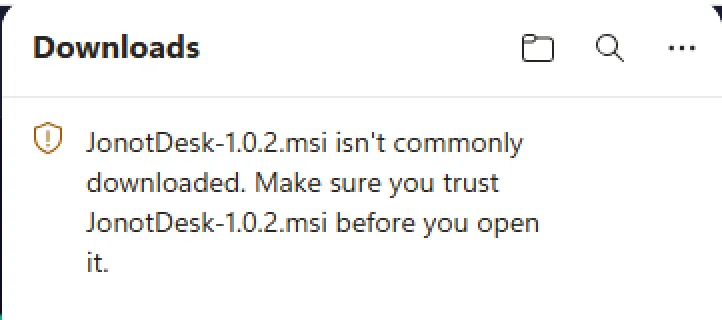
Section titled “Step 1 — allow the download in Microsoft Edge”Edge refuses to keep the file at first, showing “JonotDesk-x.y.z.msi isn’t
commonly downloaded. Make sure you trust it before you open it.” (The exact
filename depends on the link you used — the latest/ links download as
JonotDesk-latest.msi.)
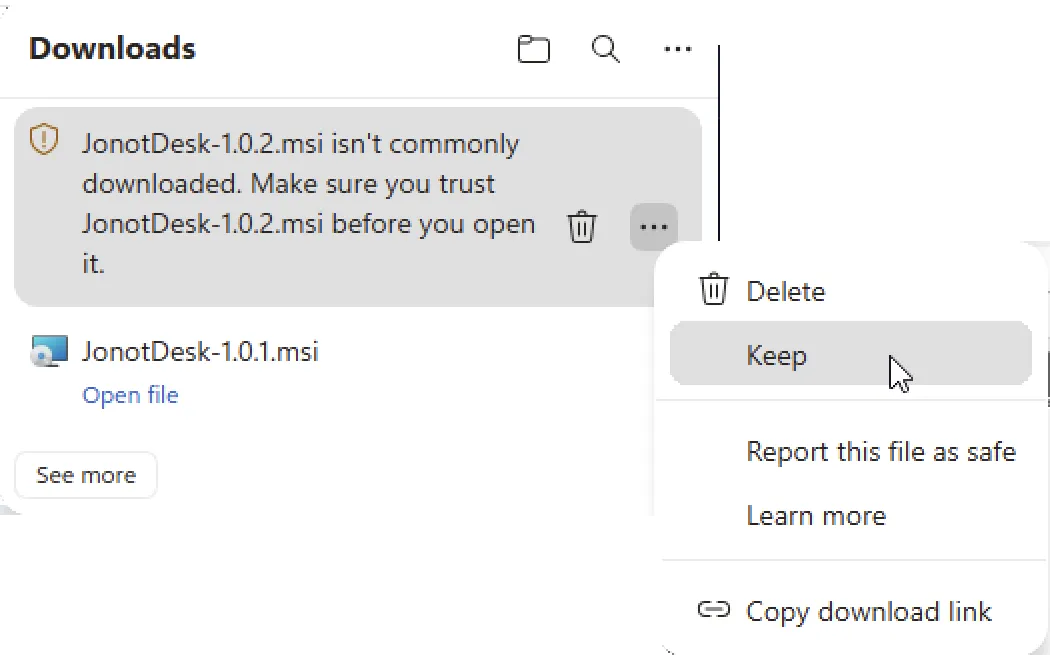
Open the Downloads panel (the ↓ icon in the toolbar), hover the blocked
item, click the ⋯ (more actions) button next to it, and choose Keep.
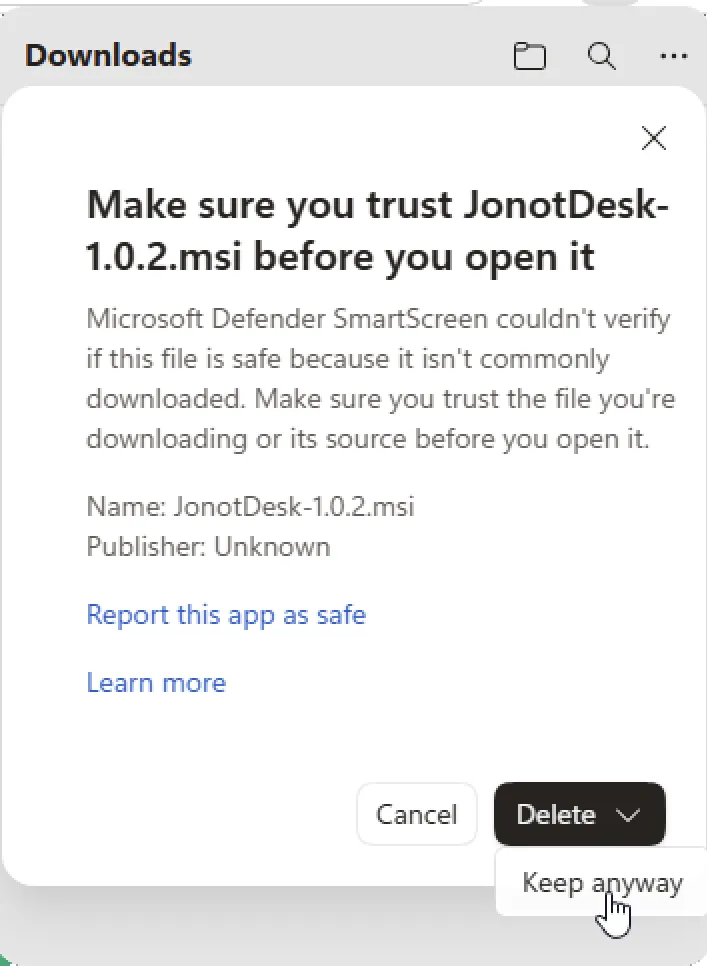
Edge asks for one more confirmation: “Make sure you trust JonotDesk-x.y.z.msi before you open it.” Click the Keep anyway button (you may need to expand the split Delete button to reveal it).
The download is now kept and an Open file link appears. Click it to launch the installer.

Step 2 — allow the app to run past SmartScreen
Section titled “Step 2 — allow the app to run past SmartScreen”The first time the installer runs, Microsoft Defender SmartScreen stops it with the message “Windows protected your PC … prevented an unrecognised app from starting.” Click More info to show the hidden Run anyway button.
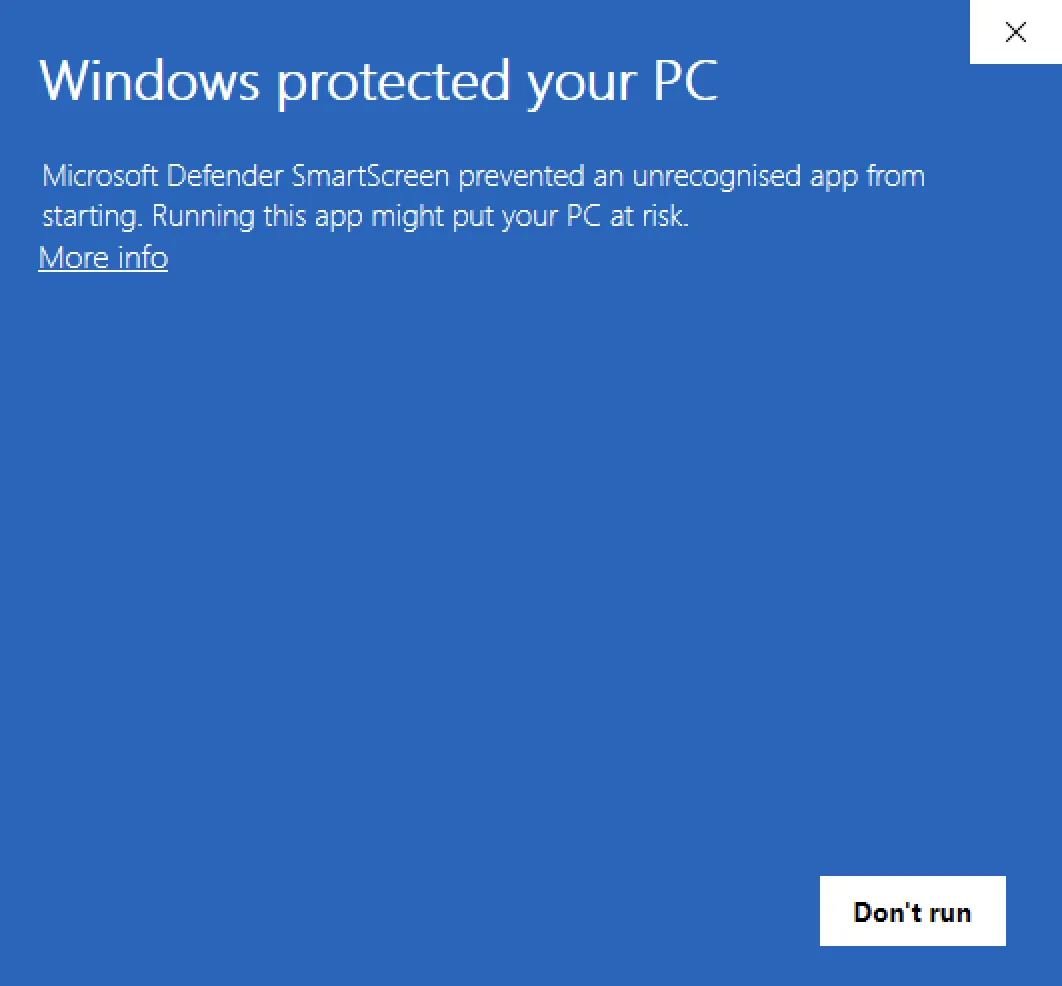
SmartScreen then shows the application name and publisher, and a Run anyway button appears next to Don’t run. Click Run anyway to start the installer.
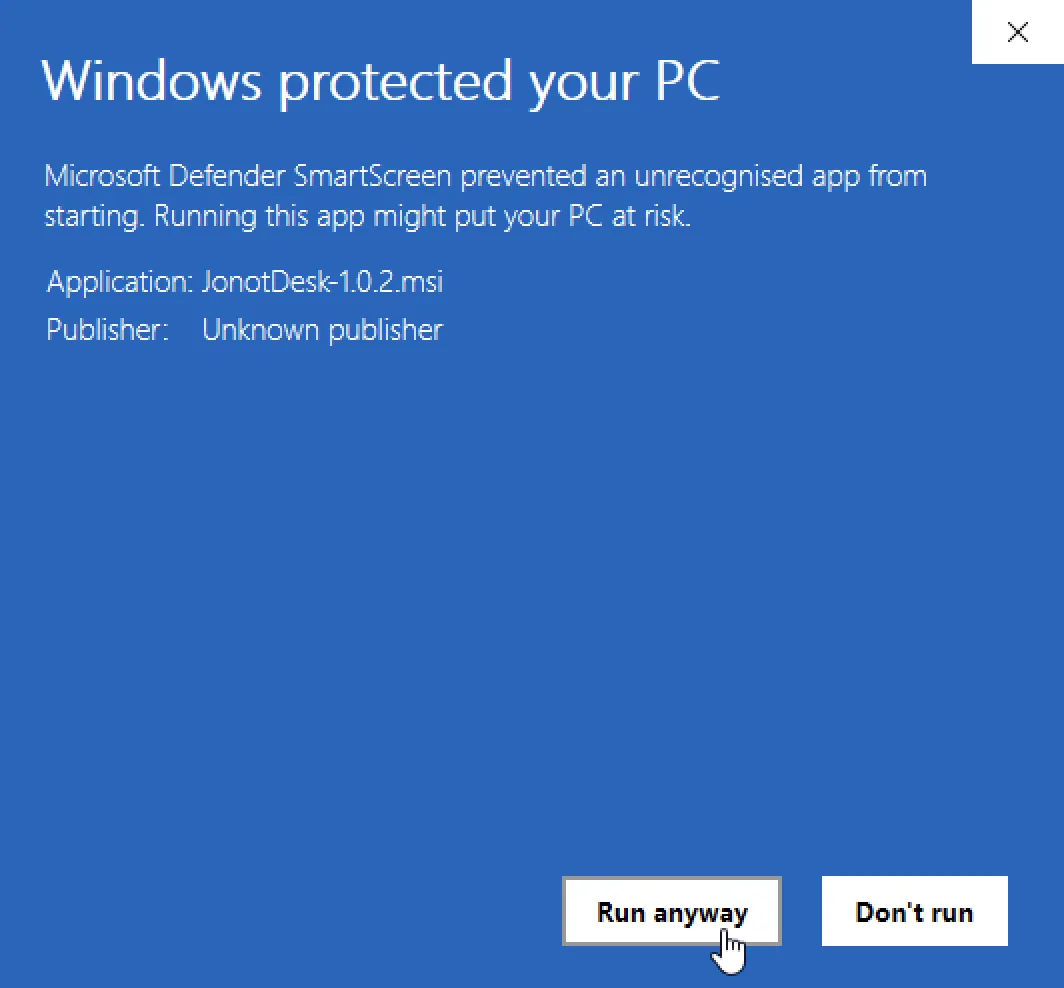
The MSI installer then continues. These prompts appear when you download and first run an installer. The installed app opens without them. WinSparkle downloads updates outside the browser, so Edge does not warn about them. SmartScreen may still warn once for an updated installer. The prompts stop after the installers are code-signed and the signing certificate gains enough SmartScreen reputation.
Android apps
Section titled “Android apps”Jonot Kiosk (Android)
Section titled “Jonot Kiosk (Android)”Tablet self-check-in kiosk.
| Install method | Link |
|---|---|
| Google Play (recommended) | Get it on Google Play |
| Direct APK (on-premises / MDM) | jonot-kiosk.apk |
Jonot Desk (Android)
Section titled “Jonot Desk (Android)”Staff desk app for calling and managing tickets.
| Install method | Link |
|---|---|
| Google Play (recommended) | Get it on Google Play |
| Direct APK (on-premises / MDM) | jonot-desk.apk |
Jonot Display (Android)
Section titled “Jonot Display (Android)”Output-only queue display for TVs, monitors, and tablets, including Android TV and Fire TV.
| Install method | Link |
|---|---|
| Google Play (recommended) | Get it on Google Play |
| Direct APK (on-premises / MDM) | jonot-display.apk |
Verify your download
Section titled “Verify your download”The desktop host, kiosk, desk, and display each publish their own
SHA256SUMS, SHA256SUMS.asc, and Jonot<App>-public.asc files
under their respective <app>/latest/ paths (e.g.
host/latest/jonot-host-public.asc, kiosk/latest/JonotKiosk-public.asc,
desk/latest/JonotDesk-public.asc, display/latest/JonotDisplay-public.asc).
All four are signed by the same Jonot release GPG key
(C2EF 70E9 7821 0056 C5C8 2F42 E588 CB26 8697 F7C3). The detached signature
is in SHA256SUMS.asc. Verify the signature to confirm that Jonot published the
checksum file. Then verify the checksum to confirm that your download matches
the published file.
The .dmg is verified by macOS Gatekeeper and notarization rather than
SHA256SUMS, so sha256sum -c --ignore-missing covers the .deb, .rpm, and
.msi but not the .dmg.
The steps below use the host as the worked example. Substitute kiosk,
desk, or display (and JonotKiosk-public.asc, JonotDesk-public.asc, or
JonotDisplay-public.asc) for the other apps.
Step 1 — download the checksum file and public key
Section titled “Step 1 — download the checksum file and public key”curl -fsSLO https://downloads.jonot.io/host/latest/SHA256SUMScurl -fsSLO https://downloads.jonot.io/host/latest/SHA256SUMS.asccurl -fsSLO https://downloads.jonot.io/host/latest/jonot-host-public.ascStep 2 — import and verify the key fingerprint
Section titled “Step 2 — import and verify the key fingerprint”gpg --import jonot-host-public.ascgpg --fingerprint C2EF70E978210056C5C82F42E588CB268697F7C3The fingerprint must match C2EF 70E9 7821 0056 C5C8 2F42 E588 CB26 8697 F7C3
exactly. If it does not, discard the download.
Step 3 — verify the checksum file signature
Section titled “Step 3 — verify the checksum file signature”gpg --verify SHA256SUMS.asc SHA256SUMSYou should see Good signature from "Jonot Release <releases@jonot.io>".
Step 4 — verify your downloaded file
Section titled “Step 4 — verify your downloaded file”sha256sum -c SHA256SUMS --ignore-missingAn OK result confirms the file is intact.
Release notes
Section titled “Release notes”See the host changelog for per-version release notes. All native app releases are also listed on the GitHub Releases page.